Exposing EGFR exon 20 insertion mutations
A distinct mutation with critical implications for detection and treatment1,2
Exon 20 insertion (ex20ins) mutations are the third most common class of EGFR mutation after classical mutations exon 19del and exon 21 L858R.3*
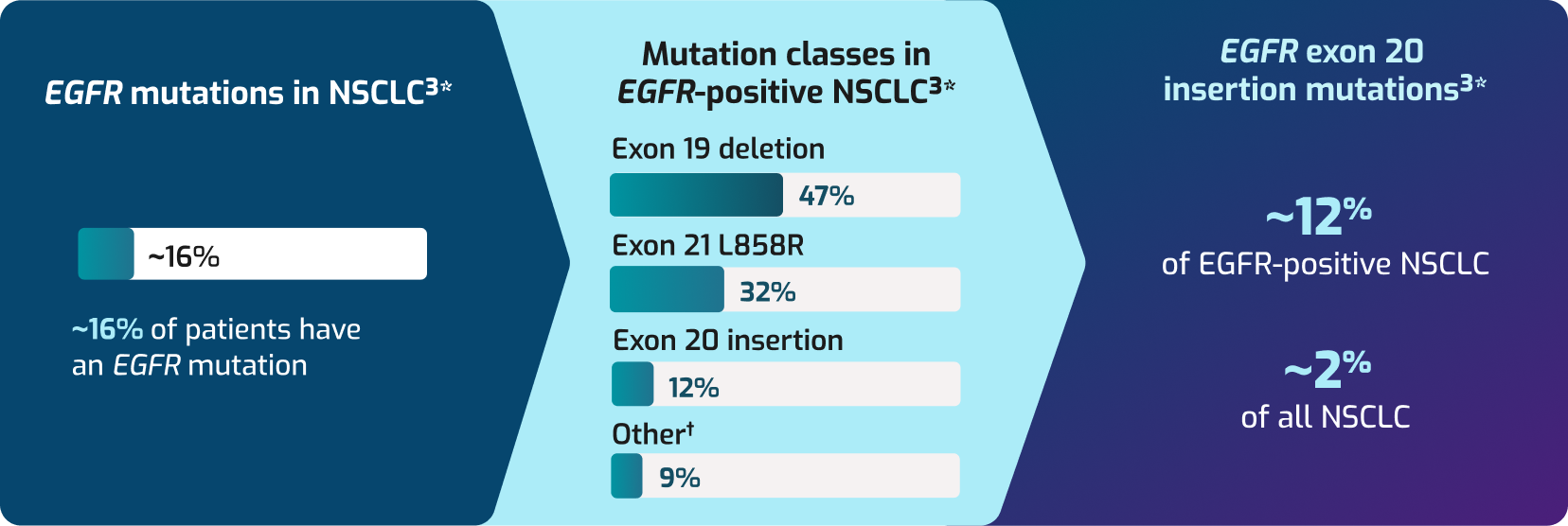
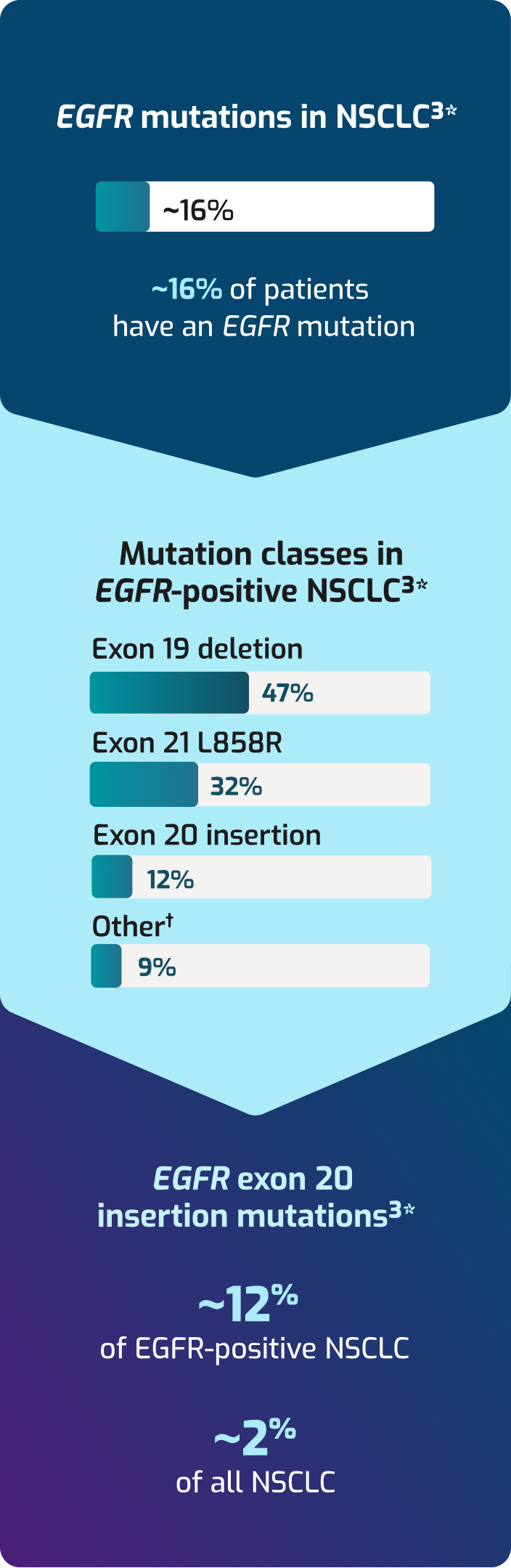
- In a study of a genomic profiling analysis of 14,483 NSCLC specimens from contributing research institutions in the U.S. and Israel. 2251 EGFR-mutant cases were identified from July 2012 to June 2016, including 263 with EGFR exon 20 insertion mutations.3
- Includes G719X (4%), L861Q (2%), S768I (1%), and cases with compound EGFR-activating mutations (2%).3
Less prevalent does not mean less significant1,4
EGFR exon 20 insertion mutations are heterogeneous at the molecular level, which can be associated with considerable variations in treatment response and clinical outcome depending on mutation subtype.5-7
Patients with EGFR exon 20 insertion mutations present with challenging clinical differentiators:

High rates of brain metastases: In an analysis, 30% of patients with ex20ins mutations presented with brain metastases.8‡
- As reported in a retrospective, real-world analysis of 357 patients with EGFR ex20ins NSCLC diagnosed from 1995-2018 across stages I-IV.8

Nearly half were nonsmokers: ~50% of patients with ex20ins mutations were nonsmokers.9§
- As reported in a retrospective study evaluating data from 2011-2020 that identified 304 patients with EGFR ex20ins advanced NSCLC.9
With prompt detection and appropriate targeted treatment, EGFR exon 20 insertion mutations may be actionable in NSCLC.4,6
Disease burden among patients with EGFR exon 20 insertion mutations remains high1,10
Despite continued advancements in the EGFR NSCLC treatment landscape, patients living with NSCLC harboring exon 20 insertion mutations may face poor outcomes when receiving conventional and non-ex20ins-directed therapies.1,7
In one retrospective cohort study of 1L patients with advanced or progressive NSCLC, those harboring EGFR exon 20 insertion mutations (n=181) showed poorer outcomes when compared to those with classical EGFR mutations11‖:

higher risk of death
Adjusted HR: 1.75 (95% CI: 1.45-2.13)

higher risk of disease progression or death
Adjusted HR: 1.93 (95% CI: 1.61-2.31)
- Based on the adjusted hazard ratio (HR) derived from a prognostic value analysis of 3014 patients (2833 with classical EGFR mutations; 181 with EGFR ex20ins mutations) in records dating from January 2011 to May 2020.11
Current practice guidelines
2026 NCCN Clinical Practice Guidelines in Oncology (NCCN Guidelines®) recommend amivantamab + platinum-based chemotherapy as a 1L option for certain patients and sunvozertinib or systemic therapy in 2L for NSCLC harboring EGFR exon 20 insertion mutations.4
While NCCN Guidelines® recommend amivantamab in 1L and 2L, toxicity management of IV-administered amivantamab remains complex and may interfere with patients' ability to stay on treatment. The subcutaneous formulation may be substituted; dosing, administration, and adverse event guidance differs.4,10,12
Precision testing enables precision medicine
The importance of biomarker testing
With timely detection and targeted treatment, EGFR ex20ins mutations may be actionable in locally advanced or metastatic NSCLC. Comprehensive biomarker testing (also known as next-generation sequencing or NGS) is essential for accurate mutation detection and selection of efficacious targeted therapies.4,6,13
Rely on NGS at diagnosis to help4,13:
- Ensure oncogenic mutations are not missed
- Support the application of matched therapies, including those that specifically target EGFR exon 20 insertion mutations
- Facilitate surveillance strategies in appropriate settings
 NGS is recommended by NCCN Guidelines for advanced or metastatic NSCLC.4
NGS detects diverse insertions across more than 98% of coding sequences. PCR targets limited mutational hotspots. Reliance on PCR alone at diagnosis may miss ~50% of patients with EGFR ex20ins.2,13,14
Starting some conventional therapies prior to mutation identification may impact outcomes of subsequent targeted treatment.15¶
- In a retrospective study of the relative risk of toxicity associated with sequential drug exposure in patients with advanced EGFR-positive NSCLC (N=126). 41 patients received PD-L1s followed by osimertinib; 29 received the reverse sequence.15
Working with your pathologist
Coordinate with your pathologist to select an appropriate NGS panel test to detect EGFR exon 20 insertion mutations at diagnosis.4
Taiho Oncology is your partner in lung cancer care
Towards a deeper understanding of rare mutation-driven cancers
Every new discovery in oncology presents an opportunity to change the lives of people living with cancer. Operating from our United States headquarters in Princeton, New Jersey, Taiho Oncology has successfully commercialized novel anticancer therapies and partnered with healthcare professionals throughout the U.S. and globally in service of this goal.

Research and development
Taiho Oncology's preclinical research and clinical development emphasizes selectively targeted oral agents, including advanced ADCs, next-generation TKIs, and other small molecule inhibitors. Agents targeting rare and challenging oncogenic mutations such as exon 20 insertion mutations are a particular focus.

Rare cancer education
Alongside our therapies, Taiho Oncology delivers educational resources that help make better patient care possible. For those treating EGFR-mutated NSCLC, we provide:
- EGFR ex20ins biology educational modules
- Tissue and ctDNA testing algorithms
- Treatment sequencing guidance

A commitment to lead
There remains a need for efficacious, tolerable therapies for challenging driver mutations such as EGFR exon 20 insertion mutations. Our growing anticancer portfolio demonstrates our commitment to the global oncology community and patients in their care.1,6,10
The role of patient advocacy
Elevating treatment support, cancer education, and vital research
Lung cancer advocacy groups like the organizations below unite patients, their care partners, and the oncology research community on behalf of a shared goal: better outcomes for people living with EGFR-positive and other lung cancers.

EGFR Resisters
We connect science and lived experience to directly improve outcomes and quality of life for people impacted by EGFR-positive lung cancer.

Exon 20 Group
Hands-on navigation for EGFR Exon 20 Warriors throughout the patient journey with clinical trials matching and oncology nursing services.

GO2 for Lung Cancer
Relentlessly confronts lung cancer on every front, every day, for everyone.

Lung Cancer Research Foundation
The mission of the Lung Cancer Research Foundation (LCRF) is to improve lung cancer outcomes by funding research for the prevention, diagnosis, treatment, and cure of lung cancer.

LUNGevity Foundation
LUNGevity is transforming what it means to be diagnosed and live with lung cancer through research, advocacy, and community.
For more insights from Taiho Oncology
Dig deeper into the challenges posed by EGFR exon 20 insertion mutations in NSCLC, and stay up to date about Taiho Oncology research and future therapies.
1L=first-line; 2L=second-line; ADC=antibody-drug conjugate; ctDNA=circulating tumor DNA; EGFR=epidermal growth factor receptor; mNSCLC=metastatic non-small cell lung cancer; NGS=next-generation sequencing; NSCLC=non-small cell lung cancer; PCR=polymerase chain reaction; PD-L1=programmed death-ligand 1; TKI=tyrosine kinase inhibitor.
REFERENCES: 1. Hu M, Zhong C, Wang J, Chen J, Zhou T. Current status and breakthroughs in treating advanced non-small cell lung cancer with EGFR exon 20 insertion mutations. Front Immunol. 2024;15:1399975. 2. Viteri S, Minchom A, Bazhenova L, et al. Frequency, underdiagnosis, and heterogeneity of epidermal growth factor receptor exon 20 insertion mutations using real-world genomic datasets. Mol Oncol. 2023;17(2):230-237. 3. Riess JW, Gandara DR, Frampton GM, et al. Diverse EGFR exon 20 insertions and co-occurring molecular alterations identified by comprehensive genomic profiling of NSCLC. J Thorac Oncol. 2018;13(10):1560-1568. 4. Referenced with permission from the NCCN Clinical Practice Guidelines in Oncology (NCCN Guidelines®) for Non-Small Cell Lung Cancer V.7.2026. © National Comprehensive Cancer Network, Inc. 2026. All rights reserved. Accessed August 10, 2026. To view the most recent and complete version of the guideline, go online to NCCN.org. NCCN makes no warranties of any kind whatsoever regarding their content, use, or application and disclaims any responsibility for their application or use in any way. 5. Bai Q, Wang J, Zhou X. EGFR exon20 insertion mutations in non-small cell lung cancer: clinical implications and recent advances in targeted therapies. Cancer Treat Rev. 2023;120:102605. 6. Kwon CS, Lin HM, Crossland V, et al. Non-small cell lung cancer with EGFR exon 20 insertion mutation: a systematic literature review and meta-analysis of patient outcomes. Curr Med Res Opin. 2022;38(8):1341-1350. 7. Ou SI, Lin HM, Hong JL, et al. Real-world response and outcomes in patients with NSCLC with EGFR exon 20 insertion mutations. JTO Clin Res Rep. 2023;4(10):100558. 8. Behera M, Jiang R, Huang Z, et al. Natural history and real-world treatment outcomes for patients with NSCLC having EGFR exon 20 insertion mutation: an international association for the study of lung cancer-american society of clinical oncology CancerLinQ study. JTO Clin Res Rep. 2024;5(6):100592. 9. Lin HM, Yin Y, Crossland V, Wu Y, Ou SI. EGFR testing patterns and detection of EGFR exon 20 insertions in the United States. JTO Clin Res Rep. 2022;3(3):100285. 10. Florez N, LeBoeuf NR, Rotow J, et al. Mitigation and management of adverse events associated with amivantamab therapy. Oncologist. 2025;30(7):oyaf194. 11. Bazhenova L, Minchom A, Viteri S, et al. Comparative clinical outcomes for patients with advanced NSCLC harboring EGFR exon 20 insertion mutations and common EGFR mutations. Lung Cancer. 2021;162:154-161. 12. RYBREVANT FASPRO [prescribing information]. Johnson & Johnson; 2025. 13. Ghoreyshi N, Heidari R, Farhadi A, et al. Next-generation sequencing in cancer diagnosis and treatment: clinical applications and future directions. Discov Oncol. 2025;16(1):578. 14. Passiglia F, Malapelle U, Normanno N, Pinto C. Optimizing diagnosis and treatment of EGFR exon 20 insertions mutant NSCLC. Cancer Treat Rev. 2022;109:102438. 15. Schoenfeld AJ, Arbour KC, Rizvi H, et al. Severe immune-related adverse events are common with sequential PD-(L)1 blockade and osimertinib. Ann Oncol. 2019;30(5):839-844.